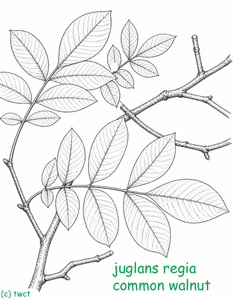
Jugland Regia - Common Walnut (non-native)
pinately compound leaves - odd numbers, usually 5-9 leaflets (unusually up to 13 leaflets)
We have recorded two of these introduced species at the edge of the woodland meadow. They provide distinctive 'signposts' for Forest School access points into the meadow and the woodland exploration area (see 'juglone' below). Introduced by the Romans.
However, these two established trees are valuable as a species that is moderately tolerant of drought. Established Common walnuts have a deep tap root that lend resilience. In keeping with the Trust's objectives to consider succession-planting with suitable native and non-native tree species - we shall keep both these trees under review.
We also need to monitor changes in ground species that tolerate moderate juglone enzymes and the shade cast by these trees. Dogs mercury (Mercurialis perennis).
Walnuts can be found locally in more open parkland, farmland and gardens. We know of a stand of mature walnuts on nearby Colyers Farm. It is unusual to find common walnuts in woodland settings except on their fringes, as here. We can safely speculate that our walnuts are 'escapees'.
Juglone: the roots and leaf-litter release an enzyme inhibitor (juglone) that suppresses the growth of some surrounding plant species. This is in evidence for both our common walnuts. We intend to manage the future cumulative impact of juglone through seasonal removal of leaf litter close to the trunk.
Biodiversity value: LOW
Even though they are non-native, they do provide nuts for mammals and leaves for some moths and micro-moths. For example, the Codling Moth (Cydia pomonella/Laspeyresia pomonella) is fond of UK walnuts but mostly known for their love of apples. They lay eggs on the tree and the caterpillars tunnel into the developing green husks to feed on the inner nut kernels.
Invertebrate leaf-suckers also enjoy the leaflets. Interestingly, there is a large, distinct aphid - the Walnut Aphid (Panaphis juglandis). Another walnut-specific aphid is the Dusky-Veined Aphid (Chromaphis juglandicola). Aphids support other insect species.
If we spot dramatic yellow-green blisters on the leaves, this may be caused by the Walnut Leaf Gall Mites (Aceria erinoea).
Propagation Options (see our summary of general techniques)
(1) Seed Collection - September-November - peak in October, pick up promptly from the ground or knock out of the tree. May take ten years before they produce their own nuts - and may not be 'true' to the parent tree.
(2) Grafting and Budding. This is the method preferred for preserving the specific cultivar and shortening the wait for fruiting (4 years).
(3) Hardwood Cuttings - rarely used.