Tree Propagation in Toll WoodTrees can be very picky when it comes to multiplying.
Objective 10 of the Trust's Ten Year Woodland Management Plan commits us to a programme of succession planting to protect the unique genetics of the woodland against the day that they age and collapse, surrender to invertebrates and/or disease, or cannot compete against more aggressive trees shading them out, or using up water and nutrients.
Toll Wood canopy will be opened-up by selective felling (halo felling), but we must invest now for the future decades that the woodland supports biodiversity in the Parish.
There are two broad propagation techniques available:
- Seed collection supports genetic diversity as pollination creates and reinforced genetic diversity;
- Cloning where seeds are difficult/impossible to use. Essentially, that means taking soft and hardwood cuttings and "layering".
We will explore multiple propagation techniques across the woodland to ensure future health and balance between our native trees and shrubs.
Our priorities for propagation
Pioneer species: Some species spread easily to occupy any available niche - so these are not our first priority for propogation. They include (for our clay/chalk conditions):
- elderberry - widely present in the wood. We can transplant saplings to the woodland edges for boundary renewal and nature's larder;
- silver birch - not found in Toll Wood but may form part of the boundary enrichment. Its absence today may be because it was 'pushed out' by other woodland species decades or centuries ago;
- sycamore - common throughout the wood. It is a very important ecological player. But, left to its own devices, sycamores create dense canopies that shade out other tree species and ground-layer plants (understorey). We plan to retain several existing mature examples but we do plan to remove sycamore before they reach twenty years old. At twenty years, sycamore start setting seed;
- scots pine - we have a dead stump that may have been out-competed! We could trial the reintroduction of this native species in due course. Not a priority;
- Aspen and Rowan (Mountain Ash) - not found in Toll Wood. Could be introduced if climate change or disease create opportunities for diversifying the woodland.
Community nursery approach: If you are able to look after seedlings/saplings in pots until they are ready for replanting in Toll Wood - or for resale locally to generate income - please contact us.
- Seed Collection Calendar
Excellent online Guides:-
- Native Trees from Seed website - the clearest guide we have found;
- The Conservation Volunteers (TCV) - including their free Guide to Autumn seed collection; and
- A Forestry Commission guide (PDF download) to harvesting, preparing, and storing seeds.
Autumn Equinox each year: 22nd September to 22nd October: This is traditionally thought of as the time for seed-collection. But a few trees set seed in spring/summer. For example, elm species.
Seed propagation creates greater biodiversity in a species. The resulting unique genetics may help future generations of trees resist disease and climate change in a way that clones cannot. This explains why elms (clones) are generally mass-felled when disease takes hold - if one tree fails, they all will. Ash has greater genetic diversity - if one ash fails, its neighbour may not. Indeed, if ash is left standing, it could recover.
Spring and summer
- Wych elm (Ulmus glabra) - Late April - late May
- Smooth-leaved/field elm (U. minor carpinifolia) - May - early June
- Wild Cherry (Prunus avium) - July
Note: English elm (U. procera) - Produces sterile seeds (as this is a clone species that naturally propogates through root suckers). Propagation is best achieved through hardwood cuttings. See "layering and cuttings", below.
Autumn Equinox [September-October]
- Elderberry (Sambucus nigra) - late August - October
- Hazel (Corylus avellana) - August - October
- Common Ash (Fraxinus excelsior) - September - October - see Note below
- Sycamore (Acer pseudoplatanus) - September - October
- Field Maple (Acer campestre) - September - October
- Beech (Fagus sylvatica) - September - November
- Hawthorn (Crataegus monogyna) - September - November
- English oak (Quercus robur) - September - December
- Native privet (Ligustrum vulgare) - September to December
- Hornbeam (Carpinus betulus) - around October
- Large-leaved lime (Tilia platyphyllos) - October
- Spindle (Euonymus europaeus) - October - November
- Blackthorn/Sloe (Prunus spinosa) - October - November
- Scots Pine (Pinus sylvestris) - dead stump - October - February
- Holly (Ilex Aquifolium) - December to February
- Common Walnut (Juglans regia) - Non-native, in meadow edges [not a priority]
2025 boundary restoration project included additional species to help improve diversity in the food reservoir throughout the year (nectar, pollen, fruit, nuts, drupes).
- Silver birch (Betula pendula) - August - December
- Dog Rose (Rosa canina) - September - December
- Yew (Taxus baccata) - September - October
- Dogwood (Cornus sanguinea) - October
Stratification: Some seeds require "stratification" - exposure to periods of warm followed by cold.
Place your seeds into a sealed container with a suitable moist medium (not water-logged) such as:
- Vermiculite: Sterile, light, and holds water well.
- Sphagnum Peat Moss: Excellent moisture retention.
- Coco Coir: Good, sustainable alternative to peat.
- Sand (Washed/Silver): Good for drainage, often mixed with other media.
- Paper Towels: Ideal for small seeds; easy to monitor for germination.
- Layering and Cuttings (creating clones) - this propagation technique is more reliable than setting/germination seed.
However, clones create genetically identical trees to the parent tree. This means saplings will be vulnerable to the same diseases as the parent. However, if you intend to multiply a disease resistant species, then layering and cuttings are ideal.
First choice for propagation is from seed collection. This is because it supports greater genetic variation and resilience of tree species for our future. But some tree seeds are notoriously difficult to germinate or the species is already a clone, such as English Elm (Ulmus procera) in Toll Wood. Ash trees propagation: Recent reports (April 2026) from the John Innes Centre tell us that seed germination can be reduced from 2-3 years to ONE WEEK! We look forward to a 'public use' germination kit becoming available in due course. In the meantime, we will experiment with layering and cuttings.
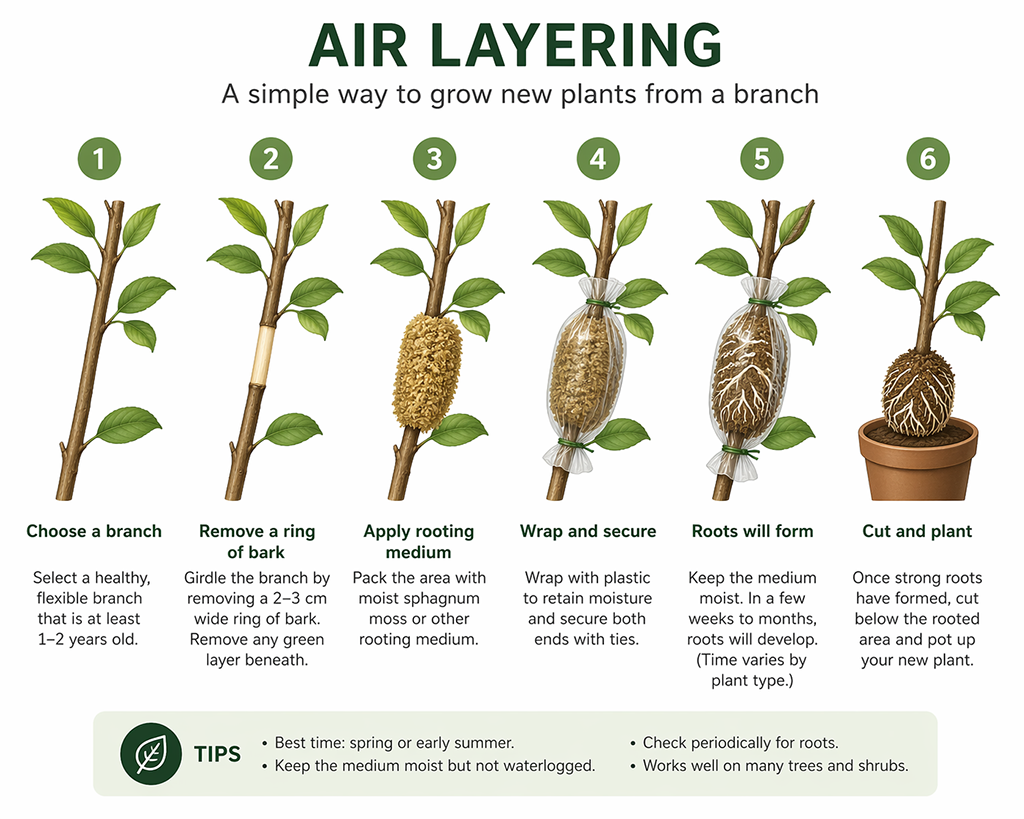
2 (a) Air Layering (or marcotting)
Image generated by CanvaAI
2 (b) Ground layering
Select a low and flexible branch. At the point that you can peg the branch to the ground - lightly damage the bark (scrape or notch the bark). Apply root hormone to the scar. Peg the branch down. Put free draining soil mix over the pegged area to help keep the area moist (not waterlogged) to aid new root formation. Leave for 1-2years for the branch to develop its own roots. Cut from the parent tree and plant the sapling immedicately.
2 (c) Hardwood Cuttings
Take 10-20cm long cuttings of healthy, firm wood from the previous season.
Remove the lower leaves and make a straight cut at the top and a sloping cut at the base (to ensure correct planting orientation).
Apply rooting hormone to the base.
Insert the cuttings into well-draining soil, with at least half the cutting submerged.
Keep in a shaded spot, or straight into a prepared nursery hedgerow, and ensure they remain moist.
2 (d) Softwood/Semi-ripe Cuttings (Summer)
Take new growth in summer.
Remove all leaves except for the top few.
Dip in rooting hormone and place in pots with moistm fee-draining compost,
Place in a shady area to develop roots, keeing them protected in winter before spring planting.