Quercus robur (English Oak)
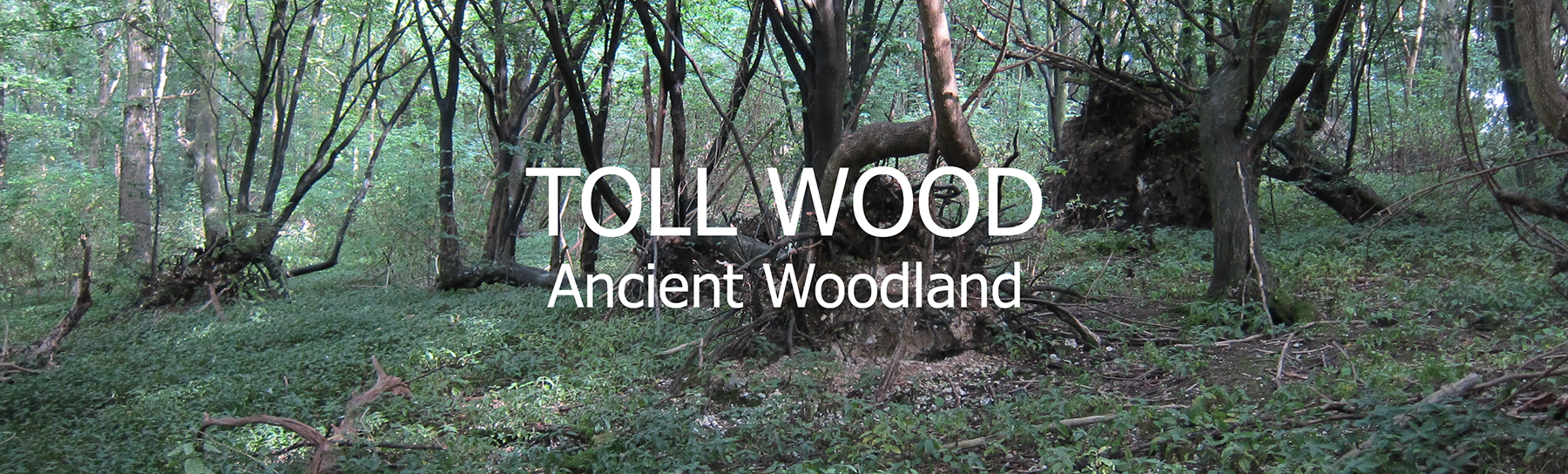
In Toll Wood - we have only two oaks, one of which is struggling to reach light at the western edge of the wood. This contrasts with the ancient maiden oak trees in the adjacent parkland in private ownership. A notable loss has occurred of a veteran oak (500+ years) in the parkland has been experience in 2025. It isn't clear why this magnificent tree has lost so many limbs over just a few years and now stands as a relic.
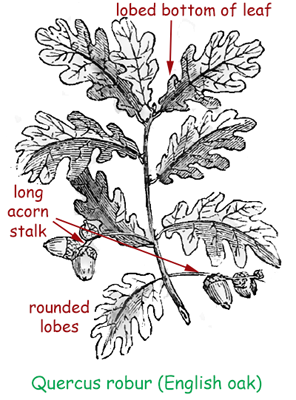
The English Oak is sometimes known as the "pedunculate oak". This refers to the acorn having a stalk (peduncle). The leaf-stalk is quite short. In contrast, the Sessile or Durmast Oak (Quercus petraea) has no stalk to the acorn and is a smaller tree. The English Oak has lobes at the base of the short-stalked leaf; the Sessile oak leaf tapers to its long stalk. Both are native to the UK.
It is worth noting that the Sessile oak is more drought tolerant and may be worth adding to our succession-planting.
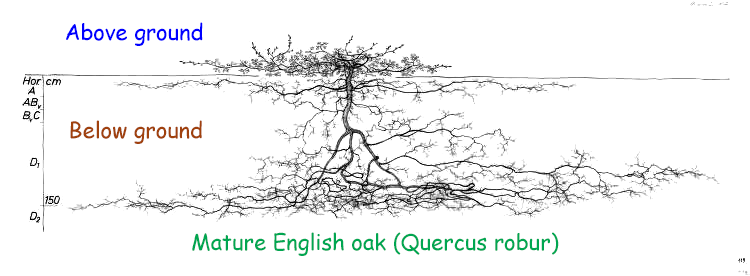
Very long-lived. the pedunculate oak is massive, sequestering huge amounts of carbon and supporting significant sustainable drainage systems (SuDS) - the root-system is very deep and widely spread. It may be that oaks are not suited to Toll Wood which sits on relatively thin soil over chalk.
Points of interest. If your oak has numerous very sharply spikey galls in an acorn cup, this is a sign of the Knopper gall wasp in residence. You must also have a Turkey oak nearby, as the gall wasp tends to alternate between two species. These are nothing to worry about. The Knopper galls used to be ground to a powder to create indelible inks selected for use on important vellum documents. 'Oak apples' and other galls are common-place and are no threat to oaks either. There are about 70 gall wasps that rely on oaks in the UK.
80-gun ships (like HMS Victory) used around 6,000 oaks in their construction. As English oaks became more scarce, ship builders began to use French oak. Even today, France continues oak forest cultivation that proved essential for the rebuilding of Notre Dame de Paris (1,500 oaks).
Oak bark is essential to leather tanning. So, there is no waste - including decaying oaks that host fungi, invertebrates, birds and mammals. The root systems are also essential habitats. For this reason, oaks are described as "keystone species" alongside ash and wood-ants (which we have in the edge of Toll Wood)!
Biodiversity value: HIGHEST
The oak is easily the most important tree for ecosystem services and biodiversity purposes. Taking all organisms into the equation, the English oak benefits 2,300 species, 326 species depend on oaks for survival, 229 species are rarely found on other trees (recommended reading: Woodland Trust article).
Close to 300 invertebrates benefit from mature oaks (both of our native oaks) alongside the many birds that feast on invertebrates and nest or roost in the crown and in holes in the trunk. Many mammals enjoy the acorns as do Jays (they also bury caches that can sprout and spread oaks across the countryside). 108 fungi species thrive on oak trees or as part of their mycorrhizal network. Not forgetting that the mature root systems offer protection to many species. Such large trees create huge volumes leaf-litter for recycling through rot and use in burrows.
Leaf fall: English oaks generally lose their leaves in late-season (mid-to-late November). Younger oaks can hold onto their leaves longer. With climate change extending warm periods, holding onto leaves for longer makes sense as a survival mechanism. But, potentially more extreme autumn storms leaves them vulnerable to wind-throw or damage to limbs if leaves remain too long. Drought also threatens oaks.
The risk to general biodiversity is enormous where disease and sudden oak death takes its toll (caused by Phytophthora ramorum that is also killing larch trees in large numbers). If you spot evidence of sudden oak death (e.g. bleeding lesions on the trunk) please email Forestry Commission or Defra Plant Health.