Prunus spinosa (Blackthorn, Sloe)
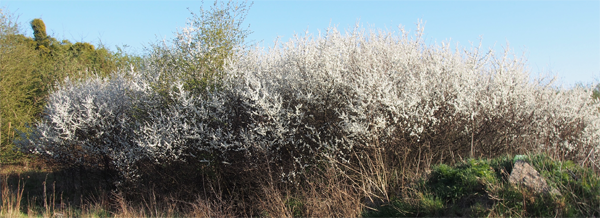
An important native woodland tree or shrub that prefers light areas at the edge of woodlands and more open glades or meadow-edge feature at the north end of Toll Wood. It is also quite thorny, which requires caution when picking any fruit that nature will allows.
Another chaotic form in a modestly-sized tree that can reach 6-7 metres height during a one hundred year lifespan. The leaves are slim and small. The fruit are about 1cm diameter.
Biodiversity value: HIGH
This is a long-lived tree that enjoys woodland, meadow edges, and open glades.
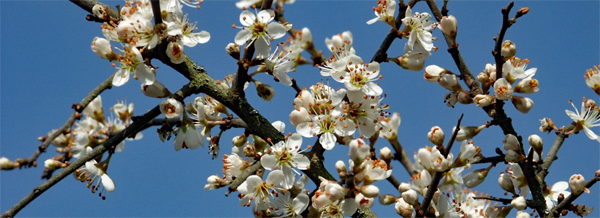
The abundant flowers are important to nectar loving insects and fruit and their stones are also important to birds and mammals (including sloe cordial and gin for us!). The blackthorn is tolerant of a wide range of environments and is drought-tolerant, so it fills an important ecological niche. The leaves can support up to 150 leaf-chewing and sap sucking invertebrates. Within this figure there are 12 leaf-miners and 6 gall-formers. The majority of insects are made up of macro and micro lepidoptera (butterflies and moths) - to find a comprehensive guide, visit the excellent Butterfly Conservation website. In short, you can never plant too many Blackthorn for their abundant and diverse contribution to the natural world.
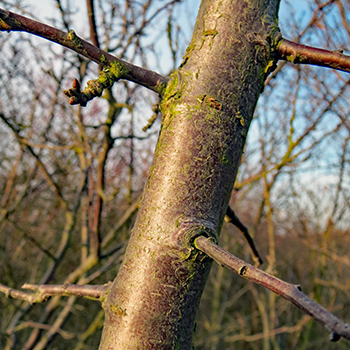
Leaf fall: Blackthorn generally lose their leaves in late-season (mid-to-late November), depending on first frosts. With climate change extending warm periods, holding onto leaves for longer makes sense as a survival mechanism. More extreme autumn storms may leave them vulnerable to some damage but is unlikely to have more threatening damage.
Propagation Options (see our summary of general techniques)
(1) Seed (stone) Collection - September-November (after leaves have fallen). Collect, remove from flesh and wash thoroughly. Expose them outdoors over winter to germinate the following spring. When 10% show signs of germination, cultivate in pots of moist sand or compost (free draining).
(2) Root Suckers (late Autumn to Spring) as an alternative to layering or cuttings. Carefully dig these up with a sharp spade when dormant. Immediately, plant into permanent site - or pots.
(3) Softwood and semi-ripe Cuttings. Softwood Cuttings - late Spring/Early Summer. Semi-Ripe Cuttings - late Summer when the base of stem is firming up. Take -3-5 inch (7.5-12.5cm) cuttings. Use rooting hormone. Plant in free-draining sand and grit. Keep moist.
(4) Ground-Layering is a reliable method for blackthorns. Bending low-hanging branches to the ground, peg the middle, and cover with soil (tip exposed). Layering creates exact replicas of the parent tree (cloning).