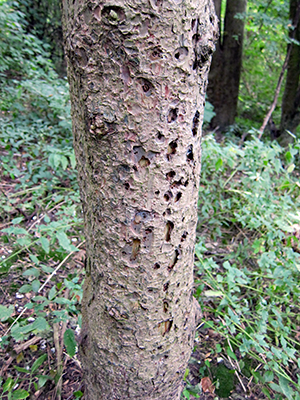
Pinus sylvestris (Scots Pine) - Dead
In Toll Wood:
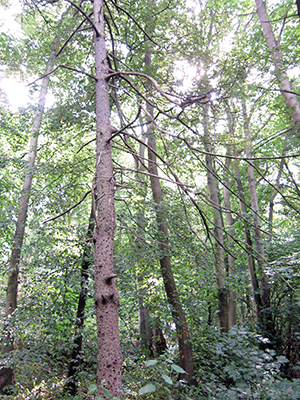
This Scots pine is fully tolerant of drought but couldn't compete against such dense cover surrounding it. The Scots Pine is wholly intolerant of shade.
Management. The stump will be retained to allow decay, predation, nesting, and invertebrates. The condition of this tree will be reviewed from time to time but it stands well back from the woodland boundary, so presents a low risk of harm.
If the species is to be retained in the long-term, it will need succession-planting at the western edge of the woodland. Potentially massive and good candidate for carbon sequestration.
Biodiversity value: LOW (as a stump); MEDIUM/HIGH (Growing)
Decay in Scots pine is a particularly important host for invertebrates and fungi. A living example offers a rich food source in its seed/cones. The foliage provides an important food-source to a large number of chewing invertebrates - beetles (Coleoptera). Also, aphids, sawflies, and macro and micro moths. A total of 91 insect species are associated with Scots pine.
Propagation Options (see our summary of general techniques) - low priority for action.
Ordinarily, propagation is based on seed collection. However, the only example in the wood is dead.
If we decide to reintroduce Scots Pine, they would have to be purchased and a suitably open are found to plant it.