Acer pseudoplatanus (Sycamore)
In Toll Wood:

Whether sycamore is 'native' or not is debated. It is classed as a 'pioneer' species, able to colonise open or scrub land quickly. Its winged seeds (samaras) spread easily, it grows rapidly, and its very large leaves create dense shade that suppresses competition in the understorey and on the woodland floor.
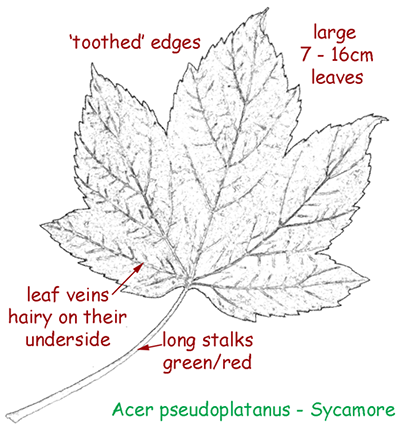
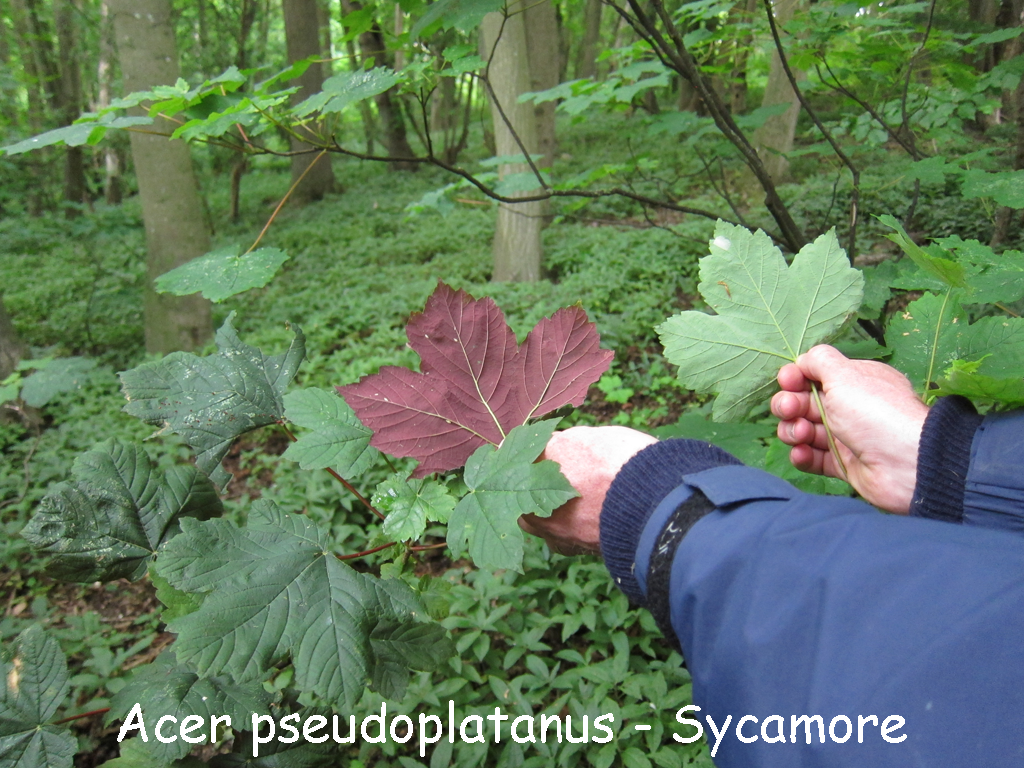
Unlike our native field maple, sycamore leaves have toothed margins. There are several well-established sycamore trees, along with a great many saplings and invasive young trees, that need to be removed to help sustain the rich mix of native apecies across the woodland as a whole. Sycamore trees are generally better suited to open or parkland planting.
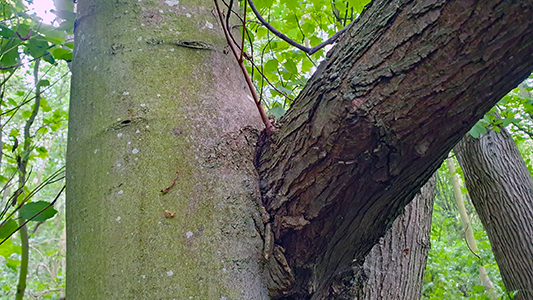
Some sycamore are more difficult to thin than others! The image (above) shows that we have 'fused' elm and sycamore!
Where sycamore is removed, we will have a clearer understanding of where there are opportunities for succession-planting. This will be particularly important in the southern sector, which is currently dominated by ash and struggling sycamore. Given the possibility of ash die-back disease, mixed planting will be important if we are to repair 'gaps' in habitat for organisms that are currently dependent on ash.
Management principle: Allow selected young sycamore to grow for about twenty years, by which time they can begin producing seed (samaras), before felling or girdling them and allowing newer sycamore to take over in providing habitat and resources for dependent species. In particular, in the southern tip of Toll Wood, some sycamore should be retained in anticipation of ash die-back, as sycamore and ash support many of the same dependent invertebrate species.
Biodiversity value: LOW/MEDIUM
In the 'right' place, sycamore can become massive, making them very good at fixing carbon. Their large leaves make the tree useful as part of a sustainable drainage system (SuDS). Their value in a woodland setting are LOW. It is host to a signicant number of leaf-chewers (32) but less so for sap feeders (11).
Leaf fall: Sycamores generally lose their leaves in mid-season (October/Early November), depending on first frosts. With climate change extending warm periods, holding onto leaves for longer makes sense as a survival mechanism. But, potentially more extreme autumn storms leaves them vulnerable to wind-throw or damage to limbs if leaves remain too long.
Propagation Options (see our summary of general techniques) - not a priority species for intervention.
(1) Seed Collection (double-winged seeds or samaras) - September-October. Sycamore produce seed/samara in maturity (after twenty years or so).
Our biggest challenge is to control the spread of sycamore seedlings! Part of our strategy is to allow some sycamore to grow for twenty years before felling in order to minimize shading of the understorey but retain their important ecological niche.(2) Cuttings and Layering can be done but this is not needed as the seed is prolific and sets itself throughout the wood!